 testy.cool
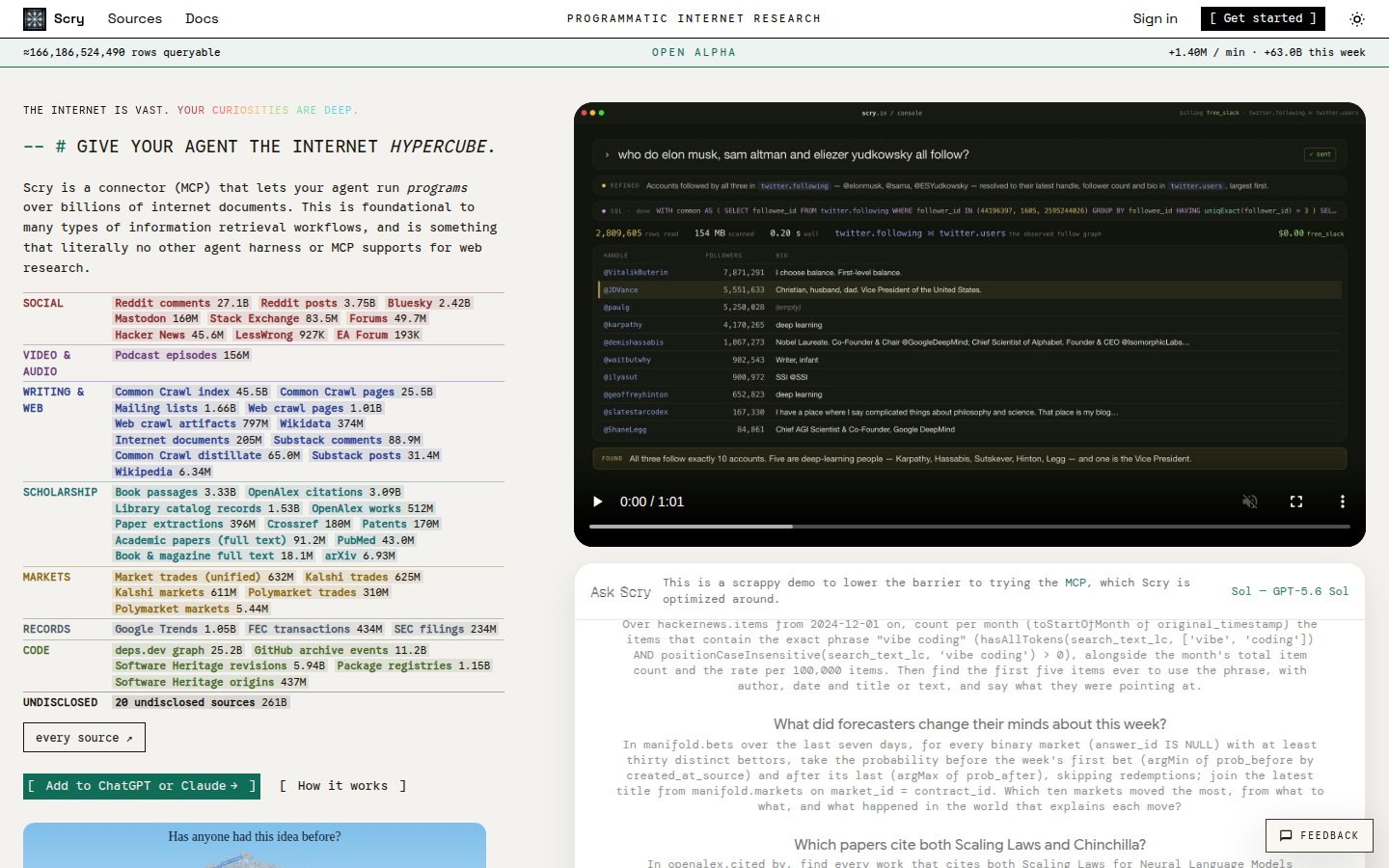
Scry is a hosted database of public internet data that you query with SQL.
You don't need to know SQL, though. Just grab the MCP URL, give it to your coding agent, sign in once and you're good to go.
At the time of writing it holds Reddit, Hacker News, the Twitter archive, YouTube, Common Crawl, live job postings and about 170 other datasets, all in one place. Everything below is real output from 21 September 2026.
Connect Scry to your agent
MCP (Model Context Protocol) is the standard way a coding agent connects to an
outside tool. Your agent reaches Scry at one address, https://mcp.scry.io. In
Claude Code:
Then run /mcp inside a Claude Code session and approve the sign-in. In
Claude.ai, Claude Desktop, ChatGPT in developer mode, or Cursor, add a custom
connector with the same address.
See what Scry holds
First, ask Scry what it holds. Scry lists its datasets in a table:
Or tell your agent to list the tables. These are the largest, by row count:
Search 27 billion Reddit comments
Scry indexes every word in its text columns, so it finds a rare word fast.
This query counts the subreddits that mention Firecrawl, a scraping tool.
hasToken matches whole words only, so firecrawl misses firecrawls.
Scry read 14,079,081 rows and answered in 367 milliseconds. Every answer also reports the rows read, the age of the data and the cost.
Find clients in 1.7 million live job postings
Every day Scry copies the public job boards that companies run on 15 hiring
platforms, such as Greenhouse, Ashby, Lever and Workday, into a table called
jobs.postings. Yesterday's copy held 1,705,242 postings.
This is very useful because Scry already does the hard part of scraping and keeping the data fresh. We can just swoop in and analyze it.
Eight of the platforms include the full job description, and Ashby includes pay when the company shows it.
Because the description is there, you can count what employers ask for (hehe).
Which AI tools employers name
Of yesterday's postings, 461,416 came with a full description. Here is how many of them name each AI tool or term:
More live job postings name Claude than name OpenAI or ChatGPT. Claude Code is in more of them than Copilot. "Vibe coding" is written into 314 real job descriptions at 195 companies.
The Claude and OpenAI rows leave out Anthropic's and OpenAI's own job boards. "Cursor" is an ordinary word too, so I only counted it when the posting also names Copilot, Claude or Windsurf. This is a plain text match on one day, and these eight platforms lean toward tech startups, so read it as a snapshot of that crowd. The whole count ran in 16 seconds and cost $0.00002.
Which companies have your problem
A job posting tells the public which problem a company has, and that the company will pay to solve it. So say you sell a web scraping service. I asked for yesterday's postings, on the eight platforms with descriptions, whose text contains "web scraping", "web scraper", "web crawler" or "data scraping", and then for a few related words:
The lines point to three kinds of possible customer. The 120 companies are about to pay for a full-time scraping engineer, and a posting often names the sites and the tools. The 67 describe, in their own words, a fight with captchas, anti-bot systems or proxies. The postings that name Zyte, Firecrawl or Apify come from companies that already pay for a scraping product, so they know the category.
The counts are rough. I matched words and did not read the postings, and some of the 120 are scraping vendors hiring for themselves. The same query works for any product. Swap the words and you get the companies hiring for your problem.
Rank any website for free
Common Crawl is a free copy of a large part of the web. From it, a table
called commoncrawl.domains ranks 358 million sites by how well the rest of
the web links to them. The rank works as a free stand-in for domain authority,
the score paid SEO tools use to say how much search engines trust a site.
The two columns are two ways of scoring a site from its links, and lower is
better in both. LIMIT 1 BY name_rev keeps one row per site, the newest. The
table stores site names reversed, so apify.com is com.apify. It leaves out
search volumes, keyword positions and lists of who links to whom.
After so many years doing SEO and scraping, I'm embarrassed I had no idea about this. I often heard about Common Crawl, but simply assumed it was something more 'sterile' and didn't have all this juicy info.
Check what it costs
It's currently in Open Alpha, and you currently get $5.00 of credit for free.
I'm not sure how it may change with time.
Scry charges for the data that comes back. Counts and lookups cost almost nothing, and bulk downloads add up:
Scry's own notes say queries are free while the system has spare capacity. My bulk downloads were charged anyway, so count and filter inside Scry and download only the rows you need.
One statement returns at most 10,000 rows, so a large download will iterate through multiple pages, and you will see each charge in the dashboard.
Trace where the data comes from
All of Scry's data is public, and each dataset says where it comes from.
- Reddit is the Arctic Shift mirror, a public archive of Reddit.
- GitHub is the Software Heritage export, an archive of public source code.
- LinkedIn pages are rebuilt from Internet Archive copies, so LinkedIn itself is never asked.
- Scry fetches job postings, Hacker News and the live web crawl itself.
The job boards publish open feeds. Each posting in Scry stores the address it
was read from, and those addresses need no key and no login. With curl, a
command line tool that fetches a web address, one request returned all 576
jobs for one company, descriptions included:
Anyone can download Common Crawl in bulk. Career pages live at addresses like
boards.greenhouse.io/<company>, so a crawl of the web contains thousands of
company names. I counted 7,035 Greenhouse boards and 10,116 Workable boards in
it. Pulling those names out is one way to build the list of boards to read.
Follow three rules when you write the SQL
Scry's SQL is the ClickHouse dialect. ClickHouse is a database built for fast counts over huge tables. Your agent handles most of this, but it helps to know:
- A statement needs a literal
LIMIT, unless it is a plain count. - Each query carries a time limit. The default is 15 seconds and the maximum is 2,000 seconds.
- A wrong column name returns the table's real column list, so the next try works.
This is amazing. And thank you to the creator @XyraSinclair.
Last updated on